Adventure

Key Project Takeaways
-
Level Design Fundamentals: Gained hands-on experience with block meshing, laying the groundwork for intricate and visually appealing levels.
-
Team Collaboration: Worked effectively within a team of four, enhancing our ability to communicate, share ideas, and solve problems collectively.
-
Individual Creativity: Each team member contributed their own level design, showcasing a variety of styles and ideas while maintaining a seamless and immersive adventure.
-
Seamless Gameplay: Focused on creating a smooth and immersive adventure, ensuring that transitions and interactions within the game were fluid and intuitive.

Vision
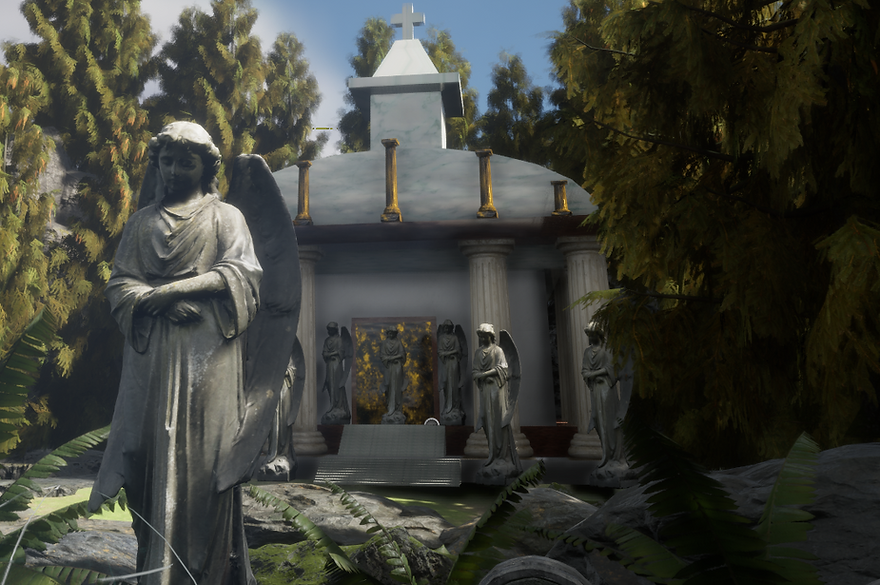
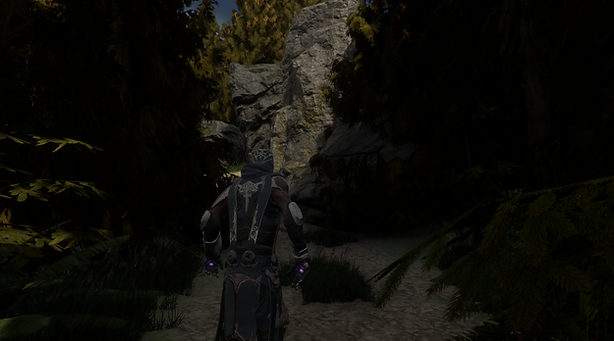
My level was inspired by the serene yet haunting beauty of the Appalachian mountains. Based on my own childhood exploring the forests within the Appalachian mountains of East Tennessee and Western North Carolina. In this segment, the player finds themselves wandering up a forest trail, eventually discovering old cabins and a desolate village, weathered by time. The design aimed to evoke a sense of exploration and nostalgia, blending natural beauty with the eerie remnants of a forgotten past.

Design Process
The Block-out
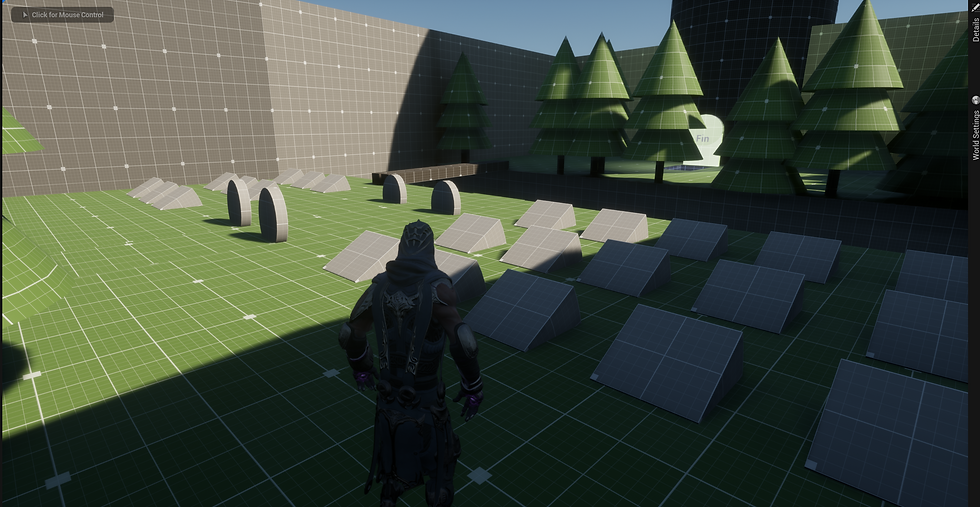
In Pre-Alpha, we performed the initial blockout and pre-planning of the level. I began by creating a vision board utilizing the Pure Ref Software. This in tandem with studying the design document provided to us. Once I had a clear image of what this level was going to become I began blocking out the level utilizing basic shapes and colors to best represent the environment I was crafting.




Research and Asset Integration
After completing the initial block out, I conducted in-depth research into the tree species and ecological characteristics of the Appalachian Mountains. This research, guided by a detailed reference sheet, enabled me to accurately envision the abandoned hidden village within its natural setting. Utilizing terrain tools, I meticulously sculpted the landscape, integrating rock assets to define the surrounding mountains and enhance the realism of the environment. This careful integration of research and assets ensured that the village felt both authentic and immersive.

Project Postmortem
Introduction:
Through the course of this project I was able to push the bounds of what I thought I was able to do when building a level or environment. In the end, I decided to pay homage to the beautiful majesty of the Appalachian mountains and really tried to drive home the feeling and experience of hiking along one of these mountain trails.
What Went Right:
-
Block Mesh- During the blackout process, I found that I was able to develop an eye for what I wanted the end result to look like, as opposed to what it currently looked like with basic color and texture that the supergrid pack provided to us. This of course really came in handy when adding the assets to the level as I already had a mental image of what I wanted the end result to look like and knew what to look for.
-
Developing Personal Processes - over the course of this project, I discovered that there are a few very simple things I can do for myself during the development process that will make my life easier as a whole. One of these is the usage of the sticky notes app, a pre-installed software on windows machines, to jot down my changelists and task lists so that I had work prepared to be started, and I was able to simply copy and paste my change notes into the source control when it came time to upload.
-
Using what I have access to - one of my biggest accomplishments through this project was being able to use what I had access to build my level. The biggest thing to note was, Assets are not as easy to find as there are a number of them. Most assets that I found that fit my project perfectly cost an exorbitant amount of money, Had massive file sizes for a single mesh, or violated the creative direction all together. So I took time to take inventory on what I did have access to and did absolutely as much as I could with that before adding files to the project.
-
Allowing the design to take form- during the initial block out of the level. I had placed a gigantic tree at my level end as a way to lure players to it. Over time, this tree began to make less sense however I was afraid to remove it. Eventually though, I did remove the tree and replaced it with a crypt / Mausoleum which I felt truthfully added to the level far more than the gigantic tree did. With this flexibility I found that I was able to more with the new ending rather than holding on to the old one.
-
Utilizing free time to perfect - During this project, I found that I had reached a state of completion very early on. However, I also learned that nothing is complete and more can always be done. So in this free time, I took time to go over the level with a fine toothed comb and make very small edits which I feel benefited overall to the level greatly.
What Went Wrong:
-
Indecisiveness - During the initial blockout process, I went through about 4 or 5 blank projects before I was able to finally decide on one set design. Where I acknowledge that nothing is truly set in stone, there were points where I restarted my level’s creation as opposed to tweaking and iterating on the level I had already created left with with less time to work on the main level and overall harmed progress in the long run.
-
Analysis paralysis - there in points in time during brainstorming that I found that I could not make a choice, which impacted the amount of time I had to work . These points came up, Most notably during the blockmesh process and during Asset Integration. This Left a few areas in my level I felt were not 100% due to this issue.
-
Perforce - There were a few points that myself and my team had issues with perforce. These issues came in the form of levels not appearing, Data going missing causing rollbacks, and other various issues. Where we did remedy most issues from using this software. We did find that the learning curve for this software caused a few setbacks.
Conclusion:
Overall, For this project, the Pros do very much outweigh the cons. The course of this project was an incredible learning experience where I was able to do my own research, make my own conclusions, and find my own personal processes when designing. The lessons I had learned for myself were invaluable and will be taken with me to the future.